
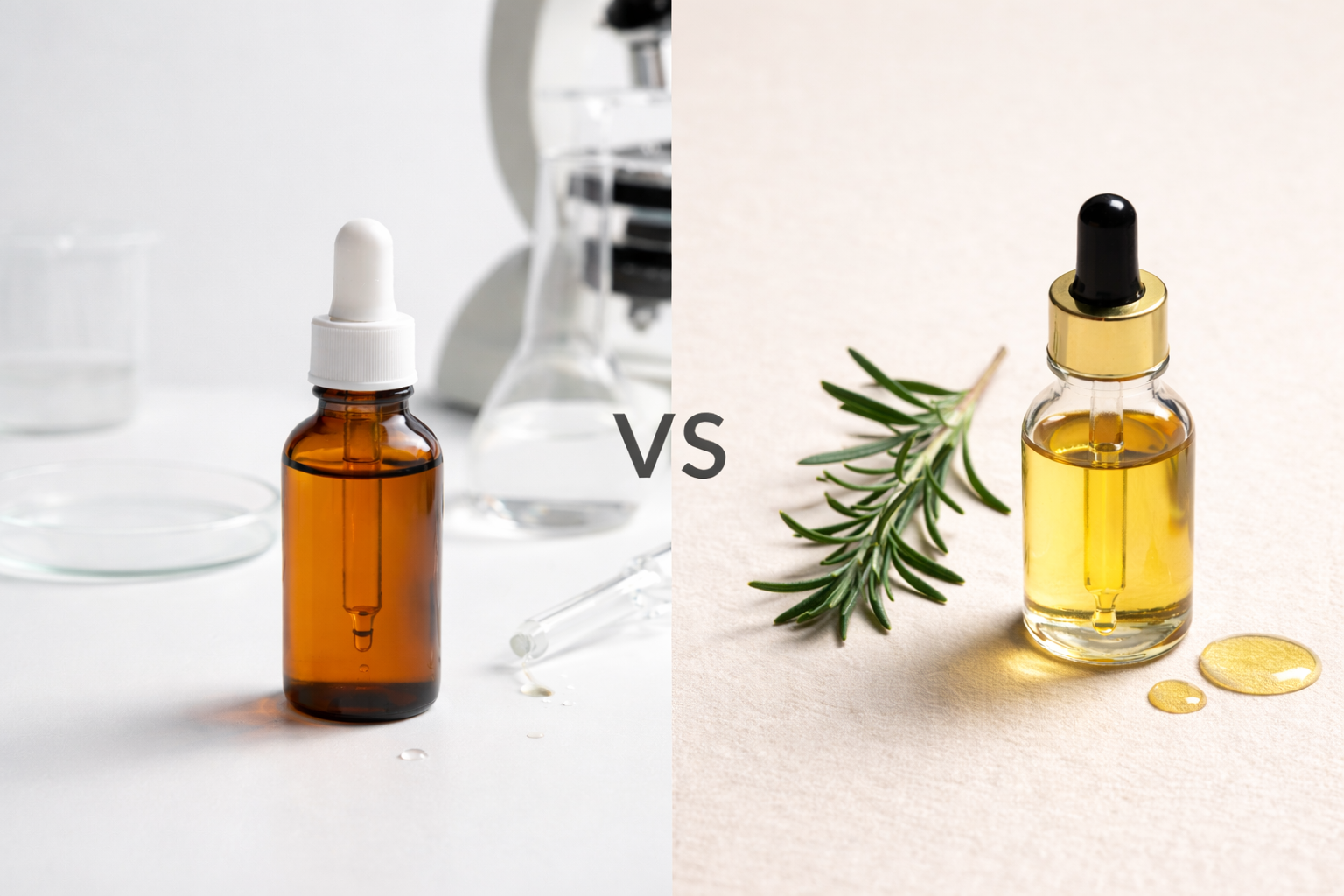
Minoxidil 2% VS (Believe It Or Not) Rosemary (I swear there are clinical studies that prove it)
If you’ve ever fallen down the TikTok rabbit hole of beautiful silky full hair and the hair oils and minoxidil that people are “using” to get there and thought, “I wonder if any of this crap actually works or if it’s all sponsored”? I promise you’re not alone. Can rosemary oil really regrow hair like Minoxidil? It sounds like a viral exaggeration but its true and actually, there’s science behind it. In fact, a 2015 clinical study found that rosemary oil performed just as effectively as Minoxidil 2% for hair growth and with none of the side effects.
Both ingredients stimulate new growth, but they couldn’t come from more different worlds. One is formulated in a lab while the other grows from that $3.99 trader joes herb bunch you bought a year ago. Let’s break down how each works, what the research shows, and which you prefer to use on your scalp.
The Science Behind Each
Minoxidil 101
Minoxidil is considered the gold standard of hair growth treatments. It’s an FDA approved topical that works by dilating blood vessels in the scalp, improving circulation, and extending the anagen (growth) phase of hair. Originally developed for blood pressure, it was later discovered to cause hair regrowth as a side effect. It’s the happy accident that’s turned into a now billion dollar industry.
Safety Check:
Vasodilator action:
Minoxidil widens blood vessels and increases blood flow to the scalp as it is a potent vasodilator. This is the reason Europe and Canada classify minoxidil as a drug.
This product is considered pharmacologically active; meaning, it doesn’t just sit on the skin. Caution to those with low blood pressure and those taking heart medication.
Systemic absorption:
1–2% of topical minoxidil can enter the bloodstream under normal conditions.
Absorption rises with irritated, inflamed, or broken skin, or when applied to large areas or too frequently.
Increased absorption may cause palpitations, dizziness, light-headedness, or mild hypotension (low blood pressure).
Individuals with naturally low blood pressure or on heart medications should use caution and medical guidance.
Use on intact skin only:
Never apply after microneedling, exfoliating acids, or recent laser treatments. I know that there are a ton of videos showing the scalp being derma rolled and microneedled with a glop of minoxidil being thrown on immediately after. PLEASE DO NOT DO THIS. There is a reason I went to school for microneedling I promise you. If you don’t allow the scalp to heal 100% you risk an almost definite risk for deeper penetration and greater systemic effects.
Pediatric exposure:
Documented case reports show generalized hypertrichosis (fine, dark hair growth) in infants exposed indirectly through caregiver’s skin contact. The condition reverses once exposure stops, but highlights how easily the medication can transfer.
Pet safety:
Even trace residue can be toxic to pets, especially cats and small dogs.
Veterinary reports link accidental ingestion or skin contact to serious cardiovascular distress in pets.
Rosemary Oil 101
Rosemary is more than a kitchen herb. It contains powerful compounds like carnosic acid and rosmarinic acid that boost circulation, calm inflammation, and even promote nerve growth factor in follicles. Think of it as a plant-based stimulant that wakes up sluggish hair roots while nurturing scalp health. These days you can see tons of TikTokers brewing up and spraying on the rosemary concoctions they’ve created. In fact the hashtag rosemary oil has over 2.3 billion views and over 300,000 video “testimonials”.
Safety Check:
Dilution is critical:
Always dilute rosemary essential oil in a carrier oil like jojoba, argan, or coconut before applying to the scalp or skin.
Never apply pure undiluted essential oil directly to skin as it can cause burning, redness, or sensitization over time.
Scalp sensitivity:
Avoid use on broken, inflamed, or freshly exfoliated skin this increases irritation risk and absorption. If you have sensitive skin perform a patch test.
Pet safety:
Rosemary oil is toxic to cats and potentially irritating to dogs if inhaled or ingested. While it dries on the scalp pretty quickly, I’d still like to PSA the following: Please don’t use rosemary oil in a diffuser if you have pets, and of course avoid pet contact when its still wet.
The Clinical Comparison
Think of Minoxidil as the prescription energy drink for hair follicles. Its synthetic, fast acting, but not always easy on the scalp and body. Rosemary oil on the other hand, is the organic espresso. It’s gentler, multi benefit, and surprisingly equally effective when used consistently.
The 2015 randomized clinical trial by the Department of Dermatology compared 2% Minoxidil and rosemary oil applied twice daily. After six months, both groups saw significant increases in hair count. The difference? The Minoxidil group reported more itching and scalp irritation, while rosemary users had smoother sailing (and shinier hair…obviously just a bonus).
So yes folks what I’m saying is, rosemary oil isn’t just a natural alternative, It’s actually equivalent if not better in most cases due to less safety risks.
| Feature | Rosemary Oil | Minoxidil 2% |
|---|---|---|
| Proven Efficacy | Comparable to Minoxidil 2% after 6 months (2015 study) | FDA-approved, decades of clinical evidence |
| Mechanism | Boosts follicle circulation, reduces inflammation | Extends hair’s growth phase |
| Results Timeline | 4-6 months | 3-6 months |
| Irritation Risk | Lower (especially for sensitive scalps) | Common (dryness, itching, flaking, shedding) |
| Bonus Benefits | Antioxidant, antimicrobial, improves scalp health | Stimulates growth only |
| Ideal For | Sensitive scalps, natural approach | Moderate to advanced thinning |
| Maintenance | Easier to taper | Requires ongoing use to sustain results |
Why Herbalists, Holistic Experts, And Ingredient Purists Favor Rosemary
Herbalists, holistic dermatologists, and ingredient purists love rosemary because it fits a more balanced and long term approach of not just hair growth but scalp care. It strengthens the follicles and nourishes the environment they grow in. Rosemary oil naturally fights microbial buildup, balances oil production, and supports barrier repair which are all things Minoxidil doesn’t address.
And for anyone with scalp sensitivity, fragrance allergies, or dry skin, rosemary offers a more tolerable path to fuller hair without the flakes or shedding phases that can happen with Minoxidil.
Why Dermatologists Prescribe Minoxidil
Dermatologists still lean toward Minoxidil because it’s not only clinically proven but FDA approved. It’s particularly effective for androgenic alopecia (hormonal or genetic hair loss) and can deliver slightly faster results. It is available in not just 2% but also 5% but remember, with the potential for a greater reward comes the potential for a greater risk.
The downside? Especially when bumping up to 5% is that it can cause dryness, shedding during the adjustment phase, and requires continuous use. Unlike rosemary oil when you stop applying it new growth will begin to regress within months.
Pro Tip
Apply diluted rosemary oil to a glass roller (linked below, less mess) and massage it into the scalp 3–4 times a week. Or if your lazy like me and that just seems like too much work, leave it on for 2–4 hours, or overnight 2-3 times a week. Wash out with a gentle, sulfate free shampoo.
And just like retinoids, remember that consistency is the key to great results.
Final Takeaway
If Minoxidil represents the “clinical fast lane” and rosemary oil the “slow and steady wins the race,” then one needs to decide if they prefer “safe and sound” or full on “pedal to the metal”.
Personally, I prefer to use technology and nature. I microneedle for hair restoration followed by the use of natural products to feed my scalp such as natural tonics, rosemary based serums and shampoos and conditioners with caffeine, peptides, or niacinamide for an extra boost.
How fast your hair can grow versus how fast it should grow will differ for everyone. Whether you’re team Rosemary, team Minoxidil, or somewhere in between, what matters most is sticking with it because results come to those who commit.
What I Look For in Hair Growth Brands
Clinical Credibility: I stick with brands that have dermatologist backed science. Meaning, the brands that have clinical studies and proven outcomes. Not just marketing buzzwords.
Ingredient Integrity: No heavy silicones or synthetic fragrance that clog follicles. I prefer lightweight carrier oils and active botanicals like caffeine or peptides.
Scalp Tolerance: The formula should soothe, not suffocate. Bonus points for niacinamide, zinc, or green tea extracts that support the scalp barrier.
Inclusivity: Everyone’s scalp and hair texture is different — dry, oily, curly, straight, chemically treated, or protective-styled. A great brand offers solutions that cover that spectrum, not a one-size-fits-all.
| Brand / Set | Key Ingredients | Claims & Benefits | Ideal For | Price |
|---|---|---|---|---|
| Gro-Baby-Gro Hair Serum + Hair Tonic Beauty Everlasting (I personally recommend to my hair restoration patients) | Rosemary & Peppermint extracts stimulate follicles and circulation; Fenugreek & Bhringraj strengthen roots; Pumpkin Seed & Saw Palmetto support fuller hair; Biotin & Silk Amino Acids fortify strands; Copper Peptides & Zinc improve scalp health; Sea Moss & Moringa restore scalp balance and hydration | Nourishes scalp, follicles, and hair shaft. Balances scalp pH and optimizes follicle function. Stimulates circulation for faster hair growth. Serum locks in moisture and antioxidants while tonic provides lightweight daily scalp nourishment | Anyone experiencing hair loss, thinning, or scalp imbalance; suitable for daily use. Can be used with microneedling or scalp care treatments | Serum $32 (1 oz) / Tonic $36 (2 oz) |
| Mielle Rosemary Mint Strengthening Shampoo + Conditioner | Rosemary oil, biotin, peppermint, saw palmetto extract | Stimulates scalp circulation, strengthens weak strands, adds shine and freshness | Anyone starting a growth journey or needing a clarifying yet nourishing cleanse | $19 set (12 oz each) |
| BondiBoost HG Shampoo & Conditioner Set for Thinning Hair with Rosemary (I personally recommend to my hair restoration patients) | Rosemary Leaf Extract, Saw Palmetto Fruit Extract, Nettle Leaf Extract, Horsetail Leaf Extract, Peppermint/Mint, Aloe Vera base | Targets hair thinning and shedding; promotes fuller looking hair; suitable for aging or weak hair; 93% of users saw less shedding in 1 month | Anyone seeing thinning hair, increased shedding, wanting a clean and luxurious formula | $61 set (16.9 oz each) |
| Briogeo Destined For Density Caffeine + Biotin Peptide Shampoo and Conditioner Set | Rosemary oil, ceramides, amino acids, algae extract | Deeply repairs damage, boosts scalp health, leaves hair visibly stronger and softer | Damaged, color treated, or over processed hair needing repair and protection | $54 set (8 oz each) |
Disclaimer The information provided on this blog is for educational and informational purposes only and is not intended as medical advice. Individual results may vary. Always consult a qualified healthcare professional before starting any new skincare treatment or regimen.